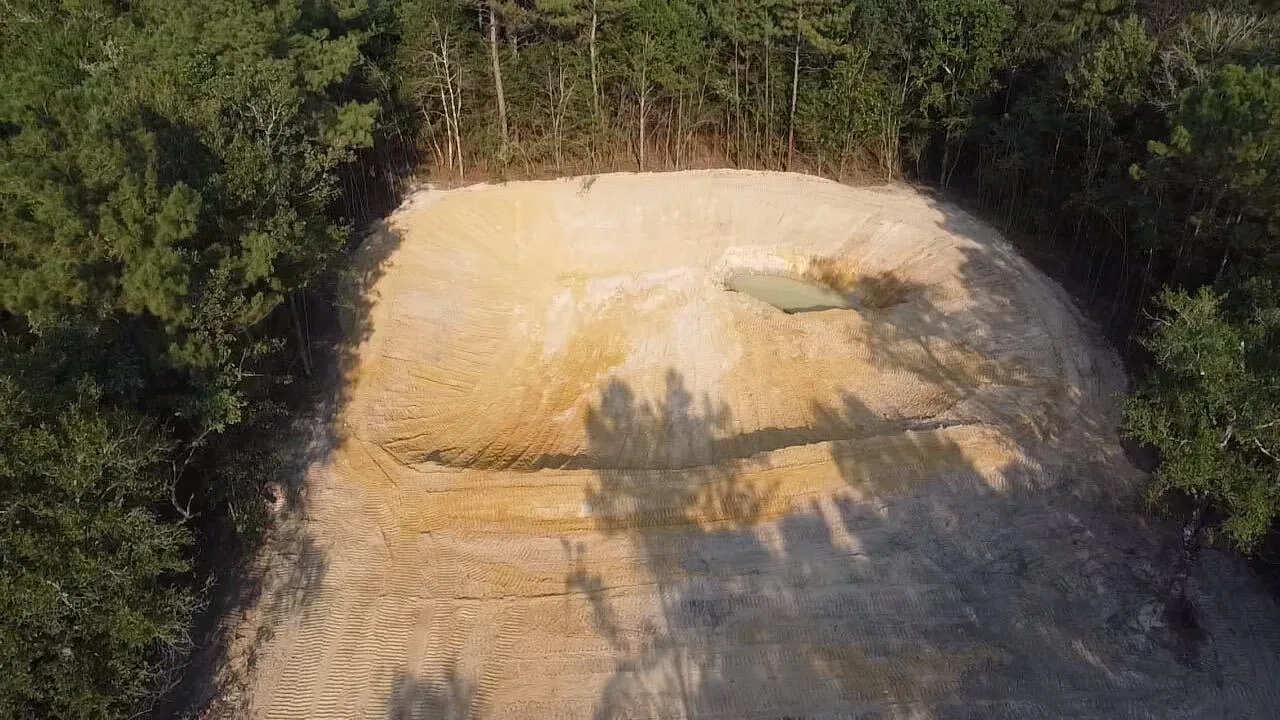
Why won’t my pond hold water?
A pond loses water two ways. It seeps out through the bottom, the banks or the dam, or it evaporates off the surface in the heat. Most ponds do some of both. The fix depends on which one is taking your water.
Evaporation is slow and it follows the weather. Seepage does not. Water going into the ground shows up as a drop the weather cannot explain. That is a dirt problem, and dirt problems get fixed with machines.
Is the pond leaking or just evaporating?
Start with how fast it drops. The Texas Water Development Board tracks lake evaporation for every one degree square in Texas. In the square that covers Buna, an average July pulls close to six inches off an open water surface. August runs about the same.
That is your baseline. A pond falling much faster than that is losing water into the ground. So is a pond that keeps falling through a cool wet month.
There is a simple field check for it. Set a bucket of pond water on a step in the pond so the water inside and outside line up. Mark both levels and leave the pond alone for a day or two.
Then compare the two marks. If both dropped about the same, you are watching evaporation. If the pond dropped faster than the bucket, you have a leak.
Next, read the dam. Seeps, wet spots and water loving plants on or below a dam mean water is moving through it. Older ponds also leak around the drain or overflow pipe. Crawfish and muskrat burrows open paths of their own.
A pond that falls fast and then steadies at one level is pointing at that waterline. Check the bank all the way around at that height for holes and soft spots. Newly dug ponds are a different case, because a lot of water soaks into the ground on the first fill. Fresh basins often seep hard until fine sediment settles in and tightens them.
| What you see | Points to seepage | Points to evaporation |
|---|---|---|
| Speed of the drop | Faster than a hot dry week explains | Slow and steady in summer heat |
| Ground below the dam | A seep, a wet spot or a green strip of water loving plants | Dry, same as the pasture around it |
| Bucket test | Pond falls faster than the bucket | Bucket and pond fall about the same |
| Time of year | Keeps falling in cool wet months | Worst in July and August |
| After a refill | Falls fast to one level, then slows | No sudden drop |
Why does Southeast Texas ground leak?
Because the ground here is not one thing. The NRCS pond handbook calls clays and silty clays excellent for holding water. It calls coarse sands and sand gravel mixes usually unsuitable. Both kinds sit within a few miles of each other around Buna.
On the holding side is the coastal prairie clay, mapped east of the Trinity River. The Beaumont series there runs 42 to 60 percent clay. It is poorly drained and its permeability is very slow. Water does not go far in that.
On the leaking side are the sandy pine uplands. The Letney series next door in Newton County is deep, well drained and moderately rapidly permeable. Doucette, another upland soil around here, is a loamy fine sand. A basin dug in either one will drink.
In between sit the flatwoods. The Evadale series, described from a site on Farm Road 2246 in Jasper County, is poorly drained. It stays saturated from the surface down to the clay below through the cool season. Soggy on top does not mean tight underneath.
That mix is why test holes come first. NRCS tells you to make soil borings at intervals over the area you plan to flood. One property can hold on one end and seep on the other. The holes are the only way to know before a machine starts.
There is one more wrinkle. Heavy clay that shrinks and swells cracks deep when it dries out. A pond in that ground can run water down those cracks on a refill. It stops once the clay swells shut, so it looks like a leak and is not always one.
What can you put in a pond to make it hold water?
The first answer is the dirt already there. Compaction alone can seal a basin that has a wide range of particle sizes and enough clay. NRCS puts that line at 10 percent clay or more. The compacted seal runs no less than 12 inches thick under water less than 10 feet deep.
If the basin is too sandy for that, it gets a clay blanket. Good blanket material carries at least 20 percent clay. It covers the pond floor and the inside face of the dam. The material goes down in layers 6 to 8 inches thick, each one compacted before the next.
Bentonite is the third dirt answer. It is a fine textured colloidal clay that swells as much as 8 to 20 times its original volume. That swelling plugs the pores in sandy soil. AgriLife Extension publishes a Texas leaflet on sealing ponds and lakes with it.
There is a catch. On drying, bentonite returns to its original volume and leaves cracks. That makes it a poor fit for a pond whose water level swings wide. A laboratory analysis of the pond soil sets the rate of application.
Two other methods exist. Chemical dispersants work only in fine grained soil carrying at least 15 percent clay. A lab test decides which dispersing agent will be most effective. Synthetic liners virtually eliminate seepage if properly installed, and they want a prepared site and a specialty installer.
Our end of this is the dirt. We draw the pond down, dig, place clay and compact it in lifts, then reshape the pond so it works. Chemical sealants and synthetic liners are a different trade, and we do not take that work.
How do you fix a pond that won’t hold water?
It starts with the water out of the way. Most repairs need the pond drained or drawn way down. Every one of them needs a basin dry enough to carry a machine.
Then you find the leak zone. There are three suspects: the dam, the outlet pipe and the basin floor. Wet ground below the dam points at the dam. A fast drop that stops at one level points at the bank at that height.
A leaking dam gets opened up and rebuilt. The core trench is recut down into tight material. It gets backfilled with the best clay on the property, compacted in thin lifts.
Loose fill goes down no more than 8 or 9 inches at a time. Cuts into an old dam are made in a broad V shape, so new fill bonds to old. Our guide to building a pond on your Texas property covers the core trench and the spillway.
A leaking basin gets the blanket. If the seepage sits in one spot, that area gets dug out and covered with a foot of clay. The clay goes in as two separate layers, each compacted on its own.
If the whole floor leaks, the whole floor gets treated. That is basin digging plus fill dirt placed and compacted. Either way the basin has to be dry before any of it starts.
While the machines are down in a dry pond, the rest gets caught up. Years of silt come out and slumped banks get reshaped and sloped. That work is cleaning out and reshaping an old pond, and it is worth doing on the same trip.
Sometimes the answer is that the site itself is wrong. A new basin in better ground can beat a third repair on a bad one. That is pond construction instead, and the permit side is laid out in our pond building guide.
When is the best time to fix a leaking pond?
When the pond is low and the ground will carry a machine. Around here that is usually late summer into early fall. Evaporation has pulled the level down by then, and the basin has had heat on it.
Rain totals do not tell the whole story. The long term normals at the Port Arthur station run 62.13 inches a year. August is the wettest month at 6.89 inches. August still works for pond repair, because the heat dries a drawn down basin fast between rains.
Winter is the trap. February is the driest month on the books at 3.09 inches. The flatwoods soils here still sit saturated at the surface all through the cool season. Low rainfall and firm ground are not the same thing here.
So the plan starts with a look. We come out and read the level, the dam and the dirt. Then we tell you what the fix takes and when the ground will allow it. The on-site estimate is free.
We are based in Buna and take pond work across Texas. Close to home that means Evadale, Kirbyville, Silsbee and Kountze. Give us a call to request a free on-site estimate while the pond is low.