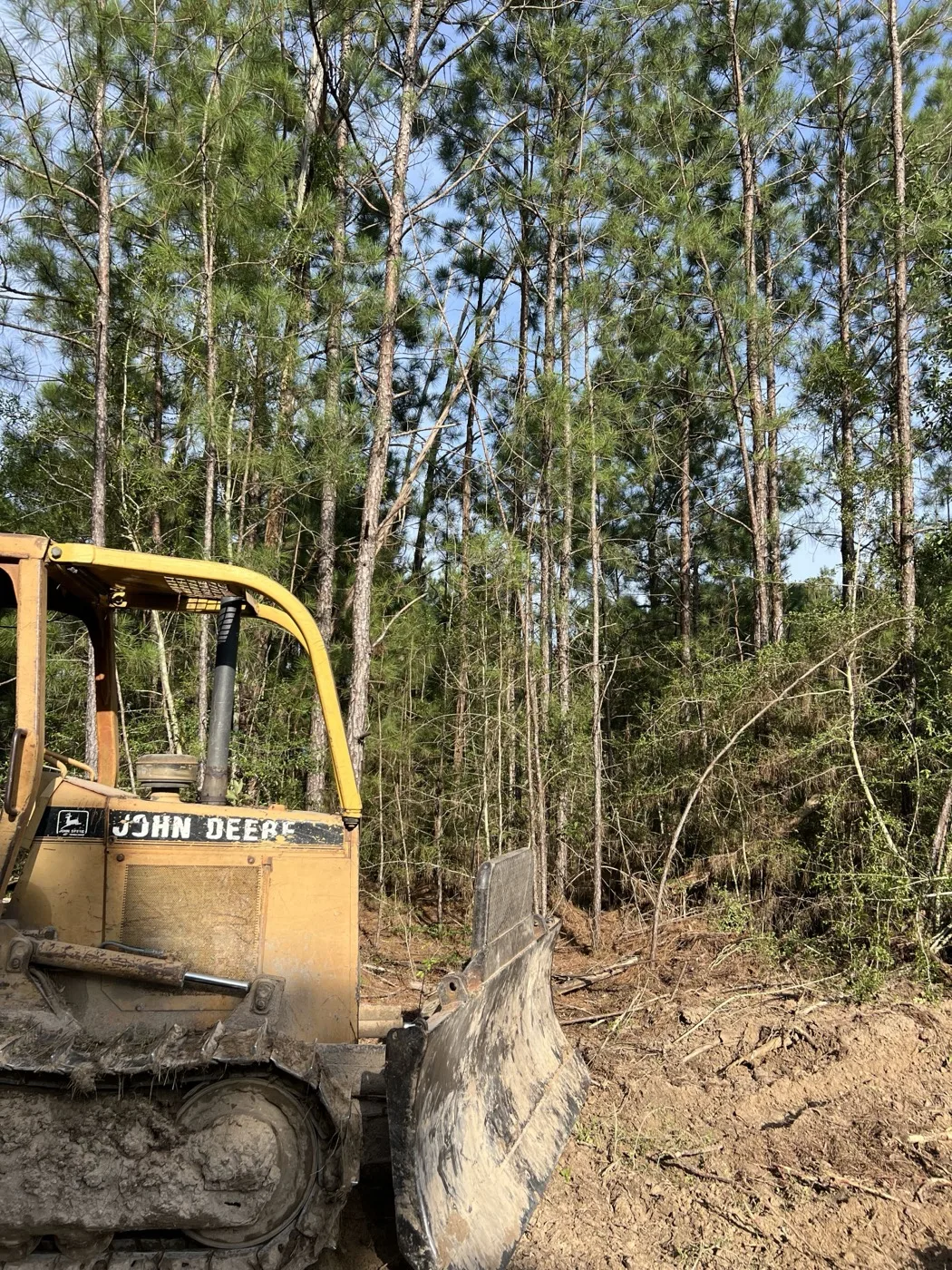
Do you need a permit to clear land in Texas?
For most rural land in Texas, no. There is no statewide land clearing permit, and on unincorporated acreage you can generally clear trees and brush on your own property without asking anyone. What the law regulates is not the clearing itself but the things around it: burning the debris, disturbing wetlands or creeks, moving dirt in a floodplain, and working inside city limits.
Those four are where landowners get surprised. Here is what each one actually requires around Buna, Jasper County, and the rest of Southeast Texas, and what we check before our own land clearing jobs.
| The activity | Who regulates it | What to check |
|---|---|---|
| Clearing trees and brush on rural land | Nobody, in most cases | City limits and the items below |
| Burning the cleared debris | TCEQ’s Outdoor Burning Rule + county burn bans | Rule conditions, the daily burn ban map |
| Clearing in wetlands or creeks | U.S. Army Corps of Engineers (Clean Water Act) | Whether the area is a water of the United States |
| Dirt work in a mapped floodplain | County or city floodplain administrator | Your flood zone, before fill or drainage changes |
| Clearing inside city limits | The city, if it has ordinances | Tree removal permits and mitigation fees |
What are the rules for burning cleared brush?
Burning is where most of the real regulation lives. Texas prohibits outdoor burning statewide, then carves out exceptions, and the one that matters here covers disposal fires: trees, brush, and other plant growth may be burned on the property where it grew, by the owner or someone the owner authorizes. Two details in that sentence do a lot of work. The material has to come from that property, and it has to burn there. Hauling cleared debris to another site to burn it is not allowed, even if you own both places.
Jasper County sits in an attainment area for air quality, which puts local landowners on the simpler path: no TCEQ notification or approval is needed for on-site brush burning, including debris from land clearing operations. The conditions still apply, and they are specific. Light no earlier than an hour after sunrise and finish the same day, an hour before sunset. Someone stays with the fire the whole time. Wind has to be predicted between 6 and 23 miles per hour, with no burning during temperature inversions. Keep the fire downwind of, or at least 300 feet from, any neighboring occupied structure unless the occupant has signed off in writing. And the pile can contain plant growth only. Treated lumber, plastics, shingles, and tires never go in, no exceptions.
One more thing the rule itself says: staying legal does not shield you from responsibility. If a burn escapes and damages a neighbor’s property, the liability is yours. That is reason enough to treat marginal weather as a no.
How do county burn bans work?
A burn ban sits on top of everything above and switches it off. County judges and commissioners courts declare bans county by county, almost always during drought, and each ban can run up to 90 days under Texas law. Violating one is a misdemeanor, but the practical point is simpler: an active ban means the debris pile waits.
Bans move constantly with conditions. As we write this in late August 2026, 178 of Texas’s 254 counties are under a ban. Jasper County is not on the list today, but Newton and Tyler counties next door both are. That is how localized it gets, and why the Texas A&M Forest Service’s statewide burn ban map, updated daily, is the first stop before any burn plan.
This is also a quiet argument for forestry mulching on brushy tracts: mulched debris never needs a burn window, so a ban cannot stall the job.
When do wetlands make clearing a federal issue?
The Clean Water Act regulates placing dredged or fill material into waters of the United States, and wetlands count. The federal rules name mechanized land clearing specifically: dozer work that pushes, drags, and redeposits soil in a wet area can be a regulated discharge that needs a permit from the U.S. Army Corps of Engineers. The same rules treat above-ground cutting differently when it leaves the root systems and soil undisturbed, which is one reason wet-adjacent tracts often get mulched rather than grubbed.
There are exemptions for established, ongoing farming and forestry operations, but they are narrower than they sound. Converting a wetland to dry land is not exempt, and the burden of showing a clearing job will not degrade a protected water falls on the person doing the clearing. Southeast Texas bottomland along creeks and sloughs is exactly the terrain where this comes up. If part of your tract stays wet, get the area evaluated and confirm your district with the Corps before machinery touches it.
What about floodplains and city limits?
Floodplains regulate the dirt more than the trees. In communities that participate in the national flood insurance program, development in a mapped flood hazard area requires a floodplain development permit before work begins, and the triggers include placing fill and altering a natural drainage course, which is squarely dirt work territory. Administration is local, so requirements differ between Jasper, Hardin, and Orange counties. The state flood portal at texasflood.org lists the floodplain administrator for every Texas community, and one call there settles whether your project needs paper.
City limits are the other line. Texas law makes tree regulation a municipal power, so cities can require removal permits and charge tree mitigation fees on private property. Outside city limits, that whole layer does not exist. Buna is unincorporated, so most land we clear around it answers only to the county and state rules above. Clearing inside Beaumont, Lumberton, or any incorporated city starts with a call to city hall.
One last local note: this corner of the Piney Woods is home range for the Louisiana pinesnake, a federally threatened species that lives in sandy, open pine woodland in Jasper and Newton counties. Large clearing projects on that kind of ground can screen the tract in minutes with the U.S. Fish and Wildlife Service’s IPaC tool. It is rarely an obstacle, and knowing beats guessing.
Rather have someone who does this every week walk it with you? We clear land across Buna, Jasper, Kirbyville, and the rest of Southeast Texas, and sorting out what a property actually needs is part of the job. Reach us through the contact page and the estimate is free.