Pond vs Lake: What Is the Difference?
There is no single size line, in law or in science, where a pond turns into a lake. The usual difference is depth. In a pond, sunlight can reach the bottom when the water is clear, so plants grow all across it. A lake is deep enough that, in at least some spots, plants cannot grow on the bottom.
Texas adds one more difference. Almost all of the state’s lakes and ponds were built by placing a dam across a stream or river. For a Texas landowner, the real gap comes down to size, depth and the dam. Our pond construction work stays on the pond side of that line.
| Pond | Lake | |
|---|---|---|
| Size | Smaller, down to less than an acre on Texas farms and ranches | Larger, up to millions of acre-feet of water |
| Depth | Shallow | Deeper |
| Light | Can reach the whole bottom when the water is clear | Does not reach the bottom in the deepest parts |
| Plants | Can root across the whole bottom | Root near the shore and around islands |
| Water temperature | About the same all the way through | Warmest on top, colder the deeper you go |
| Dam | None on a dug pond, a dam across a stream on others | In Texas, almost always a dam across a stream or river |
| Who builds it | In Texas, mostly the people who want the pond | A dam project, and big dams fall under state safety rules |
When does a pond become a lake?
It does not happen at any fixed size. The National Park Service defines lakes and ponds simply as still bodies of water surrounded by land. It says ponds are typically smaller and have their entire bottom surfaces exposed to light. Lakes, it says, are larger and murkier.
A 2022 study found that ponds lack a universal, evidence-based definition. The pond definitions it pulled together often mentioned surface area and depth. But most were written in words rather than numbers, and they varied. The team also found that government laws rarely define a pond, even when they use the word.
The team then proposed its own definition, built on size, depth and the share of emergent plants. TPWD describes emergent plants as having some of their parts sticking out of the water. The study also marked the edges of the definition for more study, so the line is still being worked out.
In Texas, the name mostly follows size. The Texas Parks and Wildlife Department (TPWD) says only very large bodies of water usually get the name reservoir. The rest are usually called a lake or a pond, depending on size.
What really separates a pond from a lake?
Depth and light do most of the work. TPWD says ponds are usually shallow enough that, if the water is clear, sunlight can reach the bottom. Then plants can grow throughout the pond. Their roots grow into the bottom and hold the soil, which helps keep the water clear.
A lake is larger and deeper. In at least some places, TPWD says, a lake is too deep for plants to grow on the bottom. Only in shallow areas, such as around the shore or islands, does enough light reach the bottom for plants. TPWD says the life along that shallow shore is like pond life.
Wind works on each one in its own way. TPWD says a strong wind can ruffle a pond’s surface, but on a lake it can whip up high waves. Waves and wind help mix air into the water.
Oxygen follows its own pattern too. In a lake, TPWD says, dissolved oxygen stays pretty even over a 24-hour period. In a pond, oxygen levels can vary widely over a day. Plants stop making oxygen at night, when there is no sunlight.
In a pond, the water stays about the same temperature everywhere. It changes quickly as the air warms or cools. Lake water in Texas is warmest at the surface and gets colder the deeper you go. At the bottom it can get as cold as 4 degrees Celsius, about 39 degrees Fahrenheit.
Ponds also fill in over time. TPWD says soil washes in from the land around a pond and makes it shallower. In time, the pond will become a wetland.
Why are almost all Texas lakes behind a dam?
Because people built them that way. TPWD says almost all of Texas’ lakes and ponds were built by placing dams across streams or rivers. That is why they can also be called reservoirs. Texas has over 200 major reservoirs and over 5,000 smaller ones.
TPWD names just one naturally formed lake in Texas, Caddo Lake. The Texas State Historical Association gives the usual explanation. Caddo formed behind a log jam in the Red River. Before its dam, it was one of the largest natural lakes in the South.
Even Caddo has a dam now. TPWD says Caddo began as a natural lake but was dammed for flood control in the early 1900s. Today, dams and reservoirs keep its waters under human control. TPWD also calls it a comparatively shallow water body.
Small ones carry a homegrown name. AgriLife Extension says Texas has more than one million ponds and small farm lakes that Texans call tanks. TPWD’s range starts with small farm ponds and stock tanks and runs up to very large reservoirs.
Do you need a permit to build a pond or a lake in Texas?
It depends on how much water you store and on the dam that holds it. Those fall under two separate sets of state rules. What follows is general information, not legal advice. A dispute goes to a Texas real estate attorney.
Texas Water Code 11.142(a) covers the water. It says, “Without obtaining a permit, a person may construct” a dam or reservoir on their own property. The limit is “normal storage of not more than 200 acre-feet of water.” It applies “for domestic and livestock purposes.”
An acre-foot is the water it takes to cover 1 acre of land 1 foot deep. The U.S. Geological Survey puts one acre-foot at 325,851 gallons. So 200 acre-feet would cover 200 acres of land a foot deep.
The dam side falls under the state’s dam safety rules (30 TAC 299.1). They apply to dams 25 feet or taller that can store 15 acre-feet or more. They also apply to dams taller than 6 feet that can store 50 acre-feet or more. Dams over 6 feet high with a high or significant hazard rating are covered whatever they store.
The Texas Commission on Environmental Quality (TCEQ) runs a Dam Safety Program. It monitors and regulates both private and public dams in Texas. Texas Water Code 12.052 also exempts the owner of some private dams from dam safety requirements. The dam has to hold less than 500 acre-feet at maximum capacity and carry a low or significant hazard rating. It also has to sit in a county of fewer than 350,000 people, outside city limits. Ask TCEQ’s Dam Safety Program which rules fit your dam.
The USDA pond handbook says the owner is responsible for obtaining permits and having the required safety inspections made. Our guide to building a pond on your Texas property covers pond permits in more detail.
How big should your pond be?
That starts with what you want the pond to do. A pond for cattle water and a pond for fishing are different digs. So is a pond that is mostly there to look good.
TPWD says most Texas ponds are built by people who want the benefits a healthy pond provides. TPWD adds that Texas lakes and ponds hold water for watering crops and ranch animals, and for fishing and boating.
The ground decides the rest. The USDA pond handbook calls clays and silty clays excellent for holding water. It calls coarse sands and sand-gravel mixes highly pervious and usually unsuitable. In plain words, water passes through them easily.
Around here, the Beaumont clay was described from a site in Jefferson County. It runs 42 to 60 percent clay. It is poorly drained, and water moves through it very slowly. The Evadale soil, described from Jasper County, sits on a flat coastal plain.
On flat ground like that, the USDA handbook says a dug pond is the simplest kind to build. It is made by digging a pit or dugout in a nearly level area. Its room for water comes almost entirely from digging, so its practical size is limited. The handbook’s other kind, an embankment pond, is made by building a dam across a stream or watercourse.
NOAA’s normal year at the Port Arthur airport brings 62.13 inches of rain. The ground under a pond has a big say in how much of it stays. If your pond keeps dropping, our guide on why a pond won’t hold water walks through the causes.
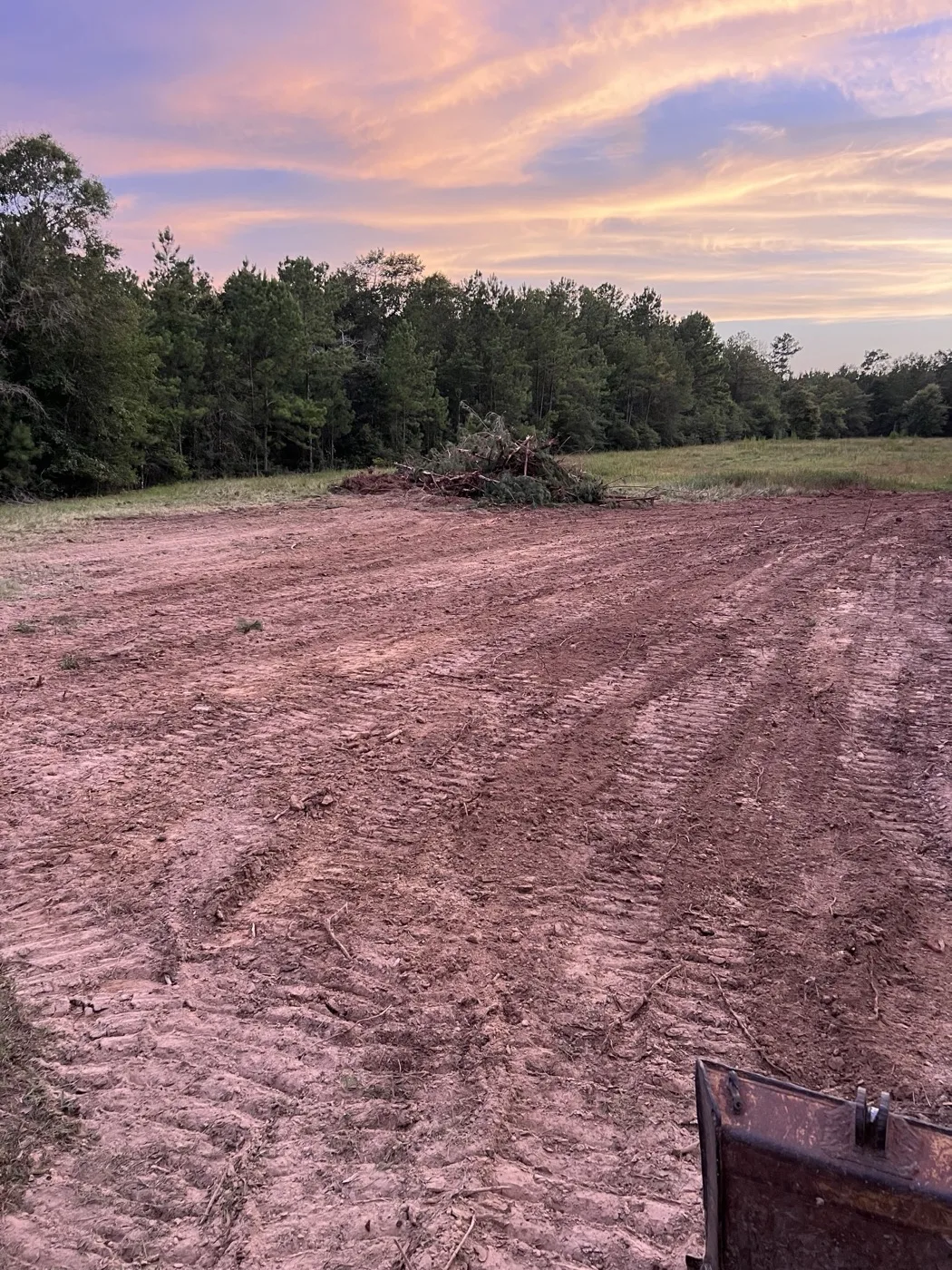
Our part is the dirt work. We clear the site, then dig and shape the pond. We shape the banks and pack them with the tracks.
The dirt that comes out is spread or shaped on site, and we grade the ground around the pond. You or your engineer set the size, the depth and any engineering. Our excavation work digs to that plan.
When a drainage plan calls for a basin, that is retention and detention pond work. For a farm or fishing pond, see how we dig stock ponds.
We work from our base in Buna out to Kirbyville, Silsbee and Kountze. Give us a call, or ask for a free on-site estimate and we will come look at your ground.