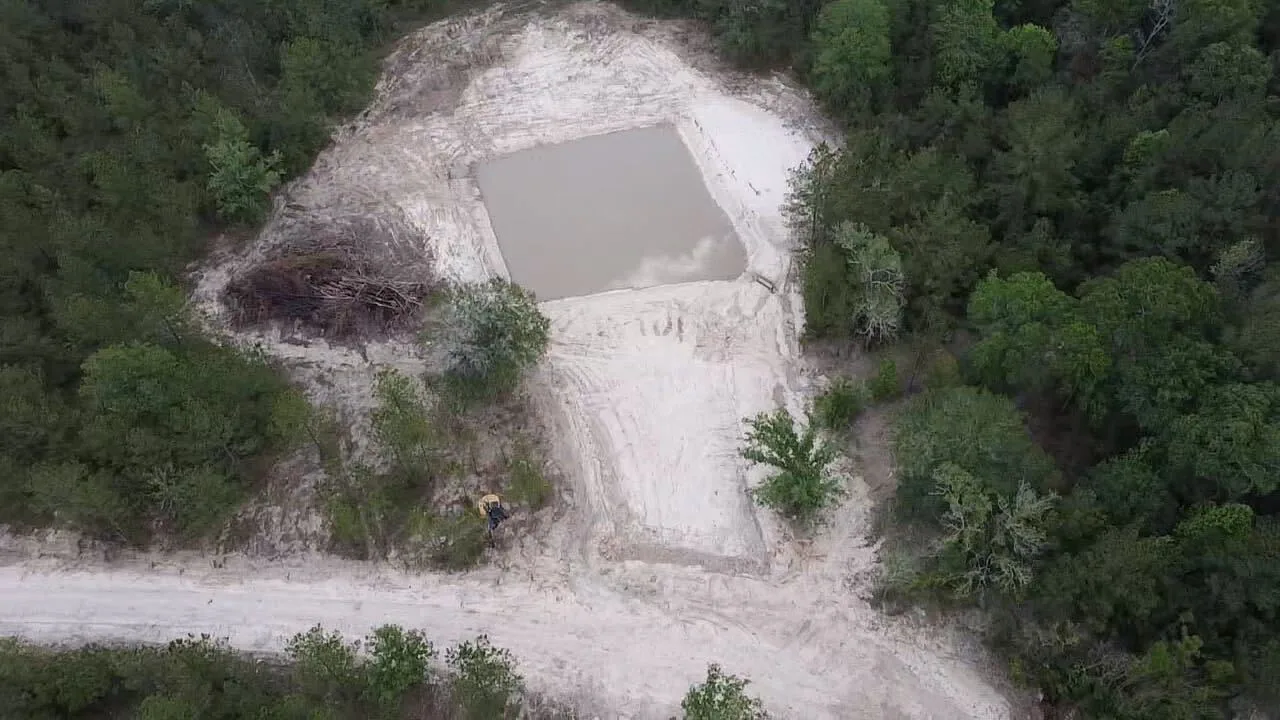
Can you build a pond on your property in Texas?
Yes. Texas law lets you build a pond on your own land holding up to 200 acre-feet of water for domestic and livestock use without a state water permit, and nearly every farm or homestead pond comes in far under that line. The decisions that make or break a pond are soil, design, and siting, not paperwork.
Still, “usually no permit” is not the same as “never a permit,” and a pond that holds water year round is a piece of engineering, not a hole. Here is how we walk through both halves on pond building jobs across Southeast Texas.
Do you need a permit to build a pond in Texas?
For a normal stock or recreation pond on your own land, usually no. The Texas Water Code exempts ponds up to 200 acre-feet built for domestic and livestock purposes, and it recognizes fish and wildlife purposes as well. Commercial operations and crop irrigation fall outside the exemption and need a water right from TCEQ.
Surface water in Texas belongs to the state, which is why the exemption exists at all. For scale, 200 acre-feet is enormous next to a real pond: a 3-acre pond running 12 feet deep at the dam stores about 14. The layers worth checking look like this:
| The layer | When it applies | A typical stock pond here |
|---|---|---|
| State water right | Storage over 200 acre-feet, commercial use, or irrigation | Exempt |
| TCEQ dam safety | Dam over 6 ft storing 50+ acre-feet, or over 25 ft storing 15+ | Usually below the thresholds |
| Federal (Corps of Engineers) | Damming a flowing creek or filling a wetland | Upland runoff ponds rarely touch it |
| County floodplain | Any dirt moved in a FEMA-mapped floodplain | Permit from the county before digging |
Two of those deserve a sentence more. On dam safety, Texas also exempts private dams under 500 acre-feet with a low hazard rating in rural counties outside city limits, which describes the typical cattle pond in Jasper, Hardin, or Orange County. On the federal side, the Clean Water Act specifically carves out farm and stock ponds for working agricultural operations, but damming a live creek or working in a wetland is a different conversation, and it happens before the machines show up.
We move dirt for a living and walk every job with this list in mind. For anything unusual, ten minutes with your county floodplain administrator or TCEQ beats guessing.
Why can’t you just dig a hole and let it rain?
Because most holes do not hold water. A pond keeps water when enough clay sits under and around it, and it survives storms when it has a real spillway. Sandy ground seeps dry, loose fill fails, and an undersized spillway takes the dam with it in the first big storm. Soil decides everything, which is why testing comes before digging.
NRCS pond guidance calls clays and silty clays excellent pond ground and flags coarse sands and sand-gravel mixes as usually unsuitable. Southeast Texas plays both sides of that line. The old coastal prairie clays east of the Trinity run 42 to 60 percent clay, the stuff everyone here calls gumbo, and it holds water beautifully. But the pine uplands around Buna, Kirbyville, and Jasper turn sandy, and a sandy site needs its clay found on site, hauled in, or worked into a compacted core to seal the basin. You can hit both conditions on one property, which is exactly why test holes across the pond footprint, a few per acre, come before any machine does.
The dam itself is not a pile of dirt either. A dam built to hold gets a core trench cut down into impervious material along its full length, backfilled with the best clay on the property and compacted in thin lifts. The fill above goes down the same way, layers about 6 inches thick, each compacted at the right moisture. NRCS puts it plainly: careless construction can make a safe and adequate design worthless.
Then the spillway, the part backyard ponds skip. A proper pond runs two: a pipe through the dam that handles everyday overflow, and a grassed emergency spillway that routes storm water around the dam instead of over it. The handbook’s warning is that a dam without enough spillway “will probably be destroyed during the first severe storm.” In country that catches 55 to 60-plus inches of rain a year, that is not a theoretical problem.
How deep should a pond be in Southeast Texas?
Six to seven feet minimum for our zone by the NRCS depth map, and at least 8 feet over part of the bottom if fish are in the plan. Depth here is less about catching water, our rainfall handles that, and more about riding out late summer, when evaporation pulls a shallow pond down fast.
Shape matters as much as the number. Wide, shallow edges are where a pond loses the most water and grows the most weeds, so a good design favors depth over sprawl. Steeper, shaped banks and a compact footprint keep more water through August than a big shallow saucer ever will.
What happens before the digging starts?
Before water is part of the picture, the site gets staked, cleared, and grubbed. Stumps and roots come out of the dam footprint completely, root holes get backfilled and compacted, and the topsoil gets stripped and stockpiled instead of wasted. Skipping any of that buries problems under the fill.
The land clearing pass on a pond site runs to the same standard as a build site, because the dam is a structure. Wood left under an embankment rots and settles, and a soft spot in a dam is not like a soft spot in a driveway. The stripped topsoil goes back at the end to dress the dam and spillway so grass takes hold, and the best clay uncovered during the excavation gets saved for the core rather than pushed out with the spoil. On overgrown tracts, we often open the wider area with the mulcher first and keep the full grubbing to the pond footprint itself. How those two approaches split a property is its own subject, and we wrote a guide comparing forestry mulching and dozer clearing that covers it.
When can you put fish in it?
The fall after it holds water, usually. Texas stocking guidance runs forage first: bluegill and redear sunfish go in during late fall while the water sits below 80 degrees, then largemouth bass the following spring once the forage has a head start. The ratio explains the order. It takes roughly ten pounds of bluegill to grow one pound of bass, so a pond stocked bass-first starves.
One note worth knowing: Texas Parks and Wildlife does not stock private ponds. Fingerlings come from private hatcheries, and AgriLife Extension publishes stocking rates by region for anyone who wants the exact numbers for the Pineywoods.
If a pond is on the list for your place around Buna, Evadale, Silsbee, or anywhere in Southeast Texas, start with the ground, not the dream. We walk the site, look at the dirt and the drainage, and tell you straight whether the spot wants to be a pond and what it needs to become one. Call (409) 289-0802 or request a free estimate.