Swale vs Ditch: What Is a Swale and Which One Does Your Land Need?
A swale is a broad, shallow channel covered in grass. Water moves through it slowly, and the grass helps treat it before it leaves. A ditch is an open channel that has traditionally been planned to move stormwater away fast.
EPA says swales do not suit very flat grades or wet, poorly drained soils. Much of Southeast Texas fits that, so a ditch cut back to a real grade often does the job here. Many places use both, a swale to gather the water and a ditch or culvert to carry it out. Our drainage and culvert work covers both ends of that job.
| Swale | Ditch | |
|---|---|---|
| Shape | Broad and shallow, with gentle grassy sides | An open channel cut to a grade |
| Main job | Carries water slowly across grass | Moves stormwater away fast |
| Best fit | Gentle slopes and soil that drains | Flat, wet ground where water has to leave |
| Upkeep | Mow the grass, EPA says to 3 to 4 inches | Clean it back to a real grade when it fills in |
What is a swale?
EPA’s 2021 fact sheet calls a grassed swale “a vegetated, open-channel management practice.” It says the practice treats stormwater and reduces how much of it flows. EPA’s 1999 fact sheet calls a vegetated swale “a broad, shallow channel with a dense stand of vegetation.” That growth covers its side slopes and bottom.
The USDA’s Natural Resources Conservation Service has a related practice called a grassed waterway. Its standard calls that “a shaped or graded channel that is established with suitable vegetation.” The waterway carries water at a speed that does not erode the soil. It uses a broad, shallow cross section and ends at a stable outlet.
EPA lists four kinds of grassed swale: the grassed channel, the dry swale, the bioswale and the wet swale. It calls all of them “improvements on the traditional drainage ditch.” The names change, but every kind is a channel with plants in it.
Our part is the dirt work. We shape a shallow, wide swale with the same dozer blade and excavator bucket we use on ditches. The grass is yours to grow and mow. We do not design or size drainage or build bioswales or wet swales.
What is the difference between a swale and a ditch?
The big difference is speed. EPA says designers have traditionally planned ditches “to rapidly convey stormwater,” which means moving it away fast. A swale moves water slowly across grass.
Shape follows the job. A swale is broad and shallow, and EPA says its side slopes are usually flatter than 3:1. That means each side runs more than 3 feet across for every 1 foot it drops.
You can often tell them apart by eye. A swale looks like a wide, gentle dip in the grass. A ditch looks like a cut channel with a clear bottom and sides.
Slope matters too. EPA says swale design documents generally recommend a 1 to 2 percent slope. That is a drop of 1 to 2 feet over 100 feet. On steeper slopes, EPA says the water moves too fast and erodes the swale.
Size is another difference. EPA says grassed swales cannot treat a very large drainage area. When a lot of ground drains to one spot, the water needs another way out, such as a ditch.
Upkeep differs as well. EPA’s upkeep list says to mow swale grass to a height of 3 to 4 inches. A ditch needs cleaning when it fills in, so it keeps its grade.
Will a swale work on flat, wet ground in Southeast Texas?
It often struggles. EPA’s 1999 fact sheet calls vegetated swales impractical on “very flat grades” and on “wet or poorly drained soils.” Much of Southeast Texas is flat ground with wet, poorly drained soil.
Take the Evadale soil, first described near Evadale in Jasper County. The USDA says it is found in Southeast Texas, mainly east of the Trinity River. It is poorly drained and lies on a flat coastal plain.
Its slopes run 0 to 1 percent, mainly less than 1 percent. That is flatter than the 1 to 2 percent slope in EPA’s swale guidance. The USDA also rates its runoff low to negligible, which means little rain runs off the surface.
Water sits in that soil, too. During the cool season, the USDA says it is saturated from the surface down to its clay subsoil. EPA says the bottom of a dry swale should sit at least 2 feet above the groundwater table. That gap keeps the swale from staying soaked, and it is hard to find in soil like this.
The Beaumont clay was described from a site in Jefferson County. It runs 42 to 60 percent clay. It is poorly drained, and water moves through it very slowly.
Water that cannot soak into clay like that has to run off or sit on top. NOAA puts a normal year at Port Arthur at 62.13 inches of rain, with August wettest at 6.89 inches.
Standing water brings its own trouble. EPA notes that wet swales can breed mosquitoes if they take 3 or more days to drain. So on flat, wet ground, a ditch cut back to a real grade often does the job. A swale can still gather water here, as long as a ditch or culvert carries it away.
When does a ditch work better than a swale?
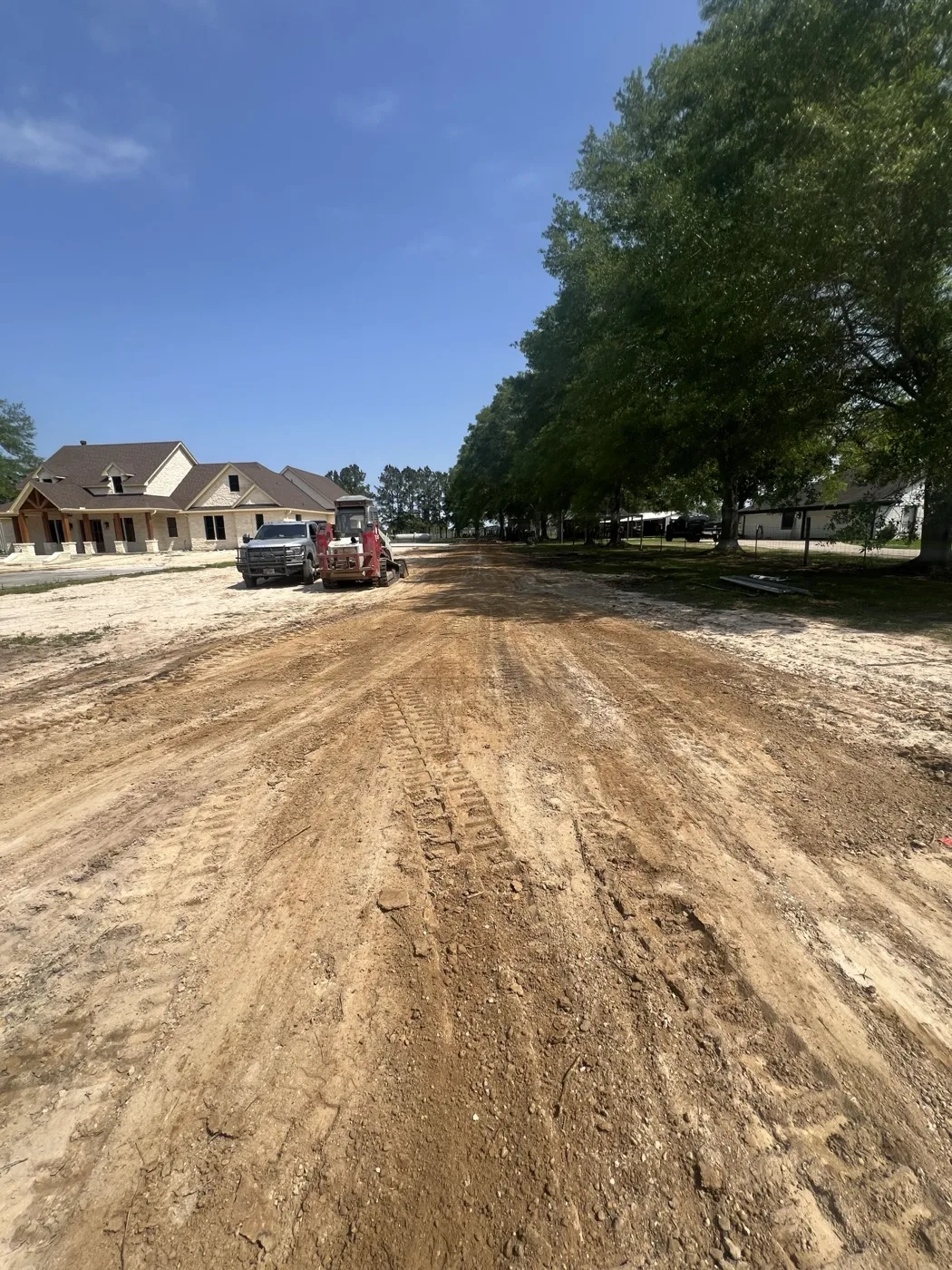
A ditch works better when water has to leave fast or the ground has too little fall for a swale. On flat ground, the ditch itself supplies the fall. Its bottom is cut back to a real grade, so water keeps moving toward an outlet.
A ditch also works better when a lot of water comes together. A swale can gather runoff from a yard, but a big flow needs a channel built to carry it. Where a ditch meets a drive or a crossing, a culvert carries the water under it.
An old ditch that has filled in stops carrying water. Cleaning it out to a real grade gets the water moving again. The excavator bucket cuts and cleans the ditch, which is part of our excavation work. The dozer shapes the ground beside it so water runs in.
Many places use both. On a lot with a house pad, a swale can carry water around the house to a ditch. The ditch then carries it on to a culvert or an outlet that can take it. When we build a pad, we build it up out of the wet and shape it to shed water.
Where the ground has the slope for it, an old ditch can also be shaped wider and shallower. That turns it into something closer to a swale. On flat, wet ground, keeping it a ditch with real fall often works better.
Before any ditch is dug, think about buried lines. Under the Texas one-call law, notice is due no later than 48 hours before digging starts. Saturdays, Sundays and legal holidays do not count toward those 48 hours.
A culvert under a drive or crossing is the only pipe we set. The rest of our water work is open ditches and shaped ground. If the ditch runs along a public road, check with your county precinct or city before any work starts. Our page on ditch cleaning and driveway culverts shows how that work goes.
Which one does your land need?
Start with what the water does after a rain. Note where it stands and where it leaves your land.
Water that stands in the same low spot points to a grading problem. Water with nowhere to go points to a ditch. A swale fits best on a small area with some slope and soil that drains.
Low spots are part of the answer too. A yard that holds water needs its low spots regraded so the ground falls toward the swale or ditch. That is land grading and leveling work, done with the dozer blade. Once the low spots are gone, the water has a steady path to follow.
Water still has to follow its natural path. Texas Water Code 11.086 says, “No person may divert or impound the natural flow of surface waters in this state.” The ban covers doing it “in a manner that damages the property of another by the overflow.”
This is general information, not legal advice. A dispute over water goes to a Texas real estate attorney. Our guide on whether a neighbor can drain water onto your property covers that law. On your land, we look at the ground and move water along its natural path.
The best time to look at a water problem is right after a rain. We work from our base in Buna out to Port Neches, Orange and Beaumont. Give us a call, or ask for a free on-site estimate and we will come look at your ground.