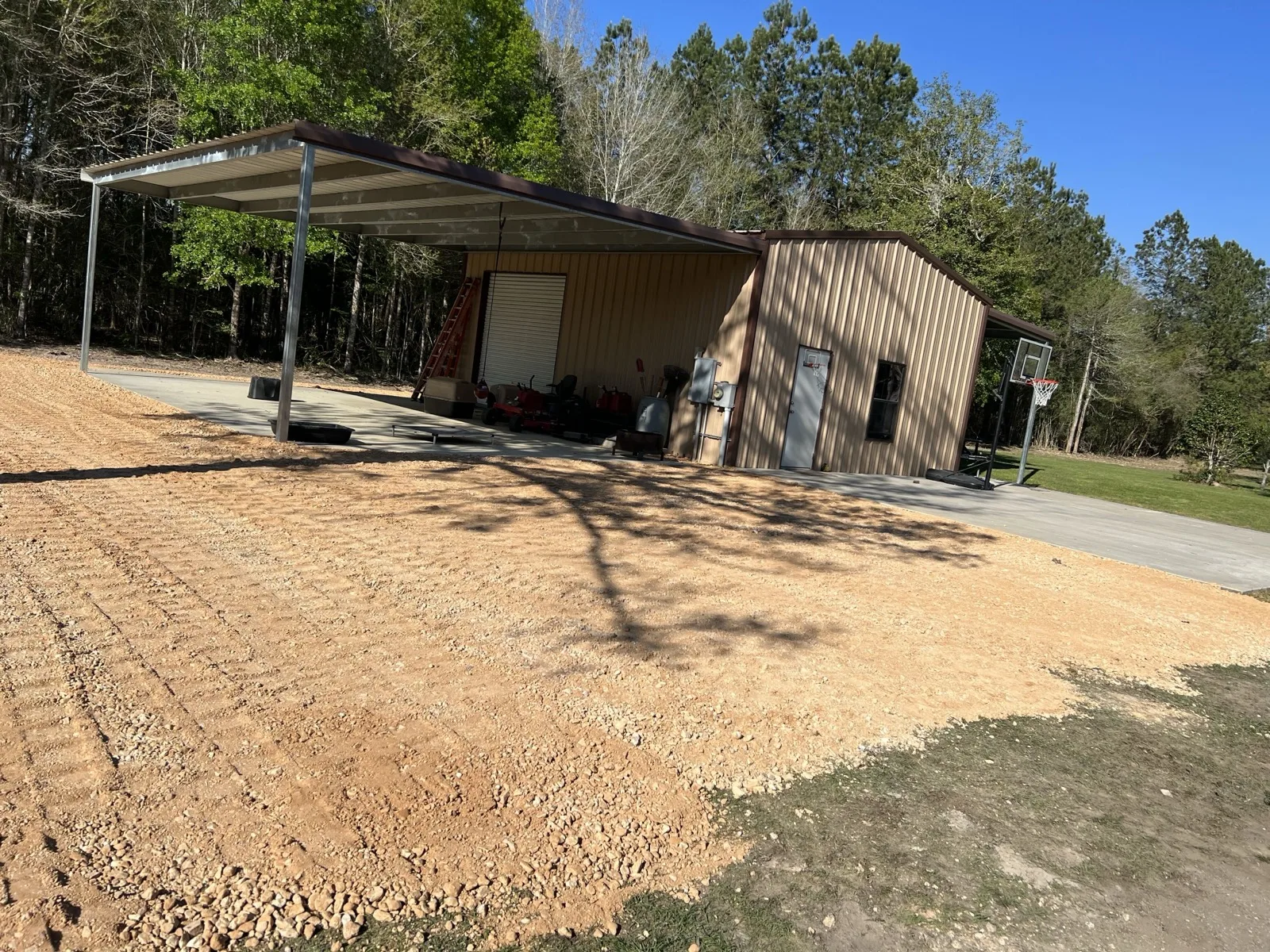
What Is the Best Gravel for a Driveway in Southeast Texas?
The best gravel for a driveway is crushed stone with the right blend of stone, sand and fines that bind. Crushed limestone and crushed concrete road base both fit. The fines help the rock pack tight and bind together. The broken faces lock, so they hold a drive better than round rock like pea gravel or river rock.
The rock is only part of the answer. The ground under it and the crown on top matter as much as the rock does. Soils here like Beaumont clay and Evadale drain very slowly, so the groundwork comes first. Our page on gravel driveways shows how we build a drive from the ground up.
What makes gravel good for a driveway?
The Federal Highway Administration (FHWA) publishes a guide to building and keeping up gravel roads. It says good gravel must have the right blend of stone, sand and fines. Fines are the smallest bits in the mix. The guide also says the stone should be fractured, which means crushed into pieces with sharp, broken faces.
The fines have a job, too. They need to bind the gravel together, and the guide calls that quality plasticity. Gravel with that blend resists washboarding, the rows of ripples that rattle a car on a dirt road. A gravel surface needs more fines and some plasticity than the base course under a paved road.
That is why base gravel makes a poor top layer on its own. FHWA describes base gravel as larger stone with very little fine material. Used on top, it will not form a crust to keep the rock bound together, so it stays loose.
A top layer needs rock with enough fines to bind, whatever name the yard uses for it. A drive that washboards or stays loose on top may have the wrong mix.
The USDA Forest Service says much the same in its guide to trails and campgrounds. Crushed rock mixed with fines and packed well is generally preferred for the top layer of trails and roads. It fits together tightly and gives vehicles a stable surface. Packed crushed rock with fines also stands up to heavy use and needs little upkeep.
Put simply, good driveway rock has two things. It has broken faces that lock and fines that bind. Rock missing either one stays loose.
Crushed limestone, crushed concrete or road base: which is best?
Crushed limestone is crushed stone. TxDOT, the Texas Department of Transportation, has a guide to flexible base. It says crushed stone, such as limestone, is the most common rock available in Texas. TxDOT’s top-rated base, Type A, is crushed stone too.
Crushed concrete is concrete broken down and crushed into rock. Both can serve as road base, and both lock together because they are crushed. Like crushed limestone, it holds best with enough fines to bind.
Road base names a job more than one kind of rock. TxDOT’s spec for that layer, the foundation course under a road, is Item 247, Flexible Base. TxDOT’s own guide shortens the name to flex base. Its types include Type A, crushed stone, and Type B, crushed or uncrushed gravel. Type D is Type A stone or crushed concrete, and Type E is caliche or iron ore.
So which is best? The flexible base guide names the strongest, most durable base. It is Type A crushed stone, or Type D where crushed concrete is allowed. The same guide says crushed material is preferred.
Gravel road base is a different story. TxDOT notes that gravels often have high clay content and are rarely used without some form of stabilization. So ask what kind of rock is in a load of road base before it goes on your drive.
For a drive, all of this points to crushed limestone or crushed concrete road base with enough fines to bind. Both are crushed, and both fit the blend FHWA describes when the fines are right. Here is how five driveway rocks compare.
| Rock | What it is | How it holds on a drive |
|---|---|---|
| Crushed limestone | Crushed stone, the most common rock available in Texas | Broken faces lock together, and TxDOT rates Type A crushed stone the strongest base |
| Crushed concrete | Concrete crushed into rock, accepted as Type D flex base | Rated with Type A as the strongest, most durable base where it is allowed |
| Road base (flex base) | Rock for the base course of a road, sorted by TxDOT into types | Crushed types hold best, and a top layer needs fines that bind |
| Pea gravel | Round gravel with very small rocks | Poor, because round rocks roll against each other and do not pack well |
| River rock | Natural stone from river deposits, where round gravel usually comes from | Poor, because rounded stone does not lock or embed like crushed stone |
Why do pea gravel and river rock roll out of a driveway?
They roll because they are round. The USDA Forest Service describes pea gravel as round gravel with very small rocks. It notes that round gravel usually comes from alluvial deposits, which rivers and streams lay down. FHWA adds that river gravels are generally a mix of stone and sand.
Round stones do not grab each other. TxDOT says rounded particles do not interlock as well as crushed particles, because they tend to roll over one another. The Forest Service calls round or pea gravels poor choices for roads and parking pads because they don’t compact well. The rocks roll against each other.
FHWA sees the same thing on gravel roads. Crushed, broken stones embed into the surface much better than rounded, natural-shaped stone. They also resist movement under loads. That is why a drive that carries cars every day holds better with crushed rock on top.
Pea gravel still has its uses. The Forest Service says it is appropriate for horse areas and around water troughs and wash racks. A driveway is a different job.
If round rock keeps rolling off your drive, more of the same will not fix it. The fix is crushed rock with fines on a crowned base.
Does the ground under the gravel matter more than the rock?
Often it does. Rock is only as firm as the ground it sits on, and soft ground lets it sink. Two soils from our part of Texas show the problem.
Beaumont clay has its type location in Jefferson County. It runs 42 to 60 percent clay and drains very slowly. On its nearly level ground, almost no rain runs off.
When Beaumont clay dries, it cracks open 1/2 inch to more than 1 inch wide. Those cracks reach 12 inches deep or more. So the same ground can be soaked in a wet spell and split open in a dry one.
The Evadale soil has its type location in Jasper County, where Buna sits. It is poorly drained and stays saturated from the surface down through the cool season.
Rain keeps coming, too. A normal year at Port Arthur brings about 62 inches of rain, and August is the wettest month. Even February, the driest month there, normally gets about 3 inches.
So a drive here has to shed water. FHWA recommends about 1/2 inch of crown per foot, roughly 4 percent, so rain runs off to the sides. The same guide says it is not good to exceed 6 percent.
Water that leaves the drive needs somewhere to go. Where the drive meets the road, the road ditch and culvert have to carry it away. Low spots beside the drive that hold water can be reshaped with land grading.
Where the ground is soft and low, we bring in fill and build it up before any rock goes down. That is the same dirt work that goes under house and barn pads. The best time for us to look at a wet drive is right after a rain.
What about shell, iron ore or recycled asphalt?
A few other materials show up on unpaved roads. FHWA notes that a few coastal regions use seashells for the surface of their unpaved roads. TxDOT lists caliche and iron ore as Type E in its flexible base spec. Its guide still rates Type A, or Type D where crushed concrete is allowed, as the strongest, most durable base.
Recycled asphalt is the tricky one. FHWA warns that recycled asphalt laid in hot weather can take on the character of pavement. It can bind so tightly that a blade can no longer work it. On a gravel drive, blading is how ruts and ripples get smoothed out.
Our work on a drive is dirt and gravel. We do not pave with asphalt or concrete. We shape the ground, crown it, bring in the rock and place it. That covers new drives and rutted drives rebuilt.
We build gravel drives from our base in Buna out to Lumberton, Evadale and Kountze. The right rock depends on your ground, so we come look at it first. Give us a call or ask for a free on-site estimate, and we will tell you what your drive needs.